Clark vs Manila for Adult English Study
If you search for English schools in the Philippines, Manila comes up constantly — it's the country's capital, its main international gateway, and home to plenty of legitimate schools. So why do a large share of serious adult learners end up choosing Clark instead? Not because Manila is a bad option, but because the two cities are built for different things.
Both are valid — so why does this question keep coming up?
This isn't a case of one city being "good" and the other "bad." Manila is a major, functioning capital with real language schools, and plenty of students study there successfully. The honest comparison is about structure and pace, not quality — and for adults focused on maximizing speaking practice in a limited window of weeks, that structural difference tends to matter a lot.
Access: two entry points, not one
Manila (NAIA) handles the largest share of long-haul arrivals into the Philippines, so it is the default assumption for many travellers. But Clark is not downstream of it: Clark International Airport (CRK) takes its own non-stop international flights — Hong Kong, Taipei, Singapore, Bangkok, Seoul, Tokyo, Doha and Dubai among them — and sits roughly 30 minutes from most CAESA campuses. So the practical choice is either a single connection at one of those hubs that lands you directly in Clark, or a Manila arrival followed by a road transfer. Routes and frequencies shift by season, so check current schedules when you book rather than assuming either path.
Pace and focus: a capital city vs a managed zone
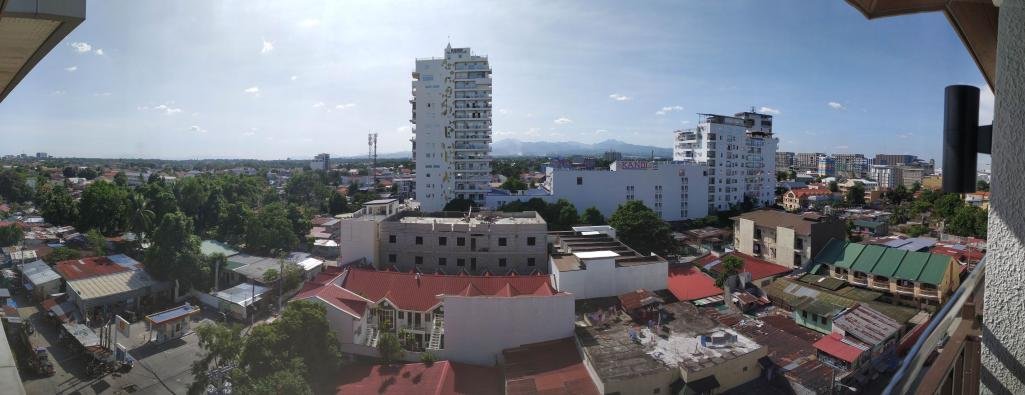
Manila is a sprawling, high-energy capital of well over a dozen million people — heavy traffic, constant noise, endless things competing for your attention. That's part of its appeal for some travelers, but it's also the opposite of what most adults want when they've taken time off work specifically to focus on English for a month or two.
Clark sits inside the Clark Freeport Zone, a managed, gated former US-airbase-turned-economic-zone. It's orderly, quieter, and purpose-built as a planned zone rather than an organically sprawling metro area — which in practice means fewer daily frictions (traffic, navigation stress, noise) eating into the energy you'd rather spend on actual study.
Distance from distraction
Manila's scale means more entertainment, more nightlife, more of everything — genuinely appealing for some travelers, but a real risk for someone trying to protect focus during a short, intensive course. Clark's smaller, contained footprint makes it structurally easier to stick to a study-heavy weekday routine, while still having malls, restaurants, golf, and weekend trips (including things to do around Clark on weekends) well within reach.
Where Manila genuinely has the edge
To be fair to Manila: it has a far bigger range of neighborhoods, restaurants, and city experiences, more direct international flight options overall, and it's the obvious base if your goal includes exploring Philippine city life broadly, not just an English course. If your priority is "experience a big Southeast Asian capital while I study," Manila is a reasonable, legitimate choice.
The adult-learner math
For most adults booking a 4, 8, or 12-week block with a specific goal — speaking fluency, IELTS, business English — the calculation usually comes down to this: a calmer, more contained environment tends to produce more consistent weekday focus, and Clark is built around that by default rather than by accident. It's also worth knowing that Clark operates as a secure, access-controlled zone — a structural safety layer worth understanding on its own; see our explainer on how the Clark Freeport Zone's gated security works.
If you're still weighing Philippine regions more broadly, not just Clark against Manila, the comparison of Clark, Cebu, and Baguio covers the other two popular options side by side, and why study English in Clark specifically goes deeper into what makes the zone work for focused adult study.
FAQ
Do I have to fly into Manila even if my school is in Clark?
No — Clark has its own international airport (CRK), with non-stop flights from hubs including Hong Kong, Taipei, Singapore, Bangkok, Seoul, Tokyo, Doha and Dubai, so a single connection at one of those can land you straight in Clark. Arriving at Manila (NAIA) and continuing by road is the other common option. Routes and frequencies change by season, so check current schedules before booking, and your school can advise on the onward transfer.
Is Manila unsafe compared to Clark?
Not inherently — Manila is a normal, functioning capital city with the usual big-city precautions. The real difference is pace and structure, not safety: Clark's gated Freeport Zone offers a calmer, more contained environment, which suits a focused study schedule particularly well.
Which city is better for nightlife and city exploring?
Manila, by a wide margin — it's a much larger, more varied capital. If exploring Philippine city life is as important to you as the English course itself, Manila is worth serious consideration.
How far is Clark from Manila?
Clark is reachable from Manila by road, commonly used by students arriving through NAIA before transferring to their Clark campus. Exact travel time depends on traffic and route, so confirm current transfer options with your school.
Ready to see how a managed, study-focused environment fits your goals? See the 8 CAESA schools or get in touch with questions about arrival and location.